PEAX
Heartbeat: AI-driven end-to-end test framework
Senior Frontend Engineer & Applied AI Engineer
Heartbeat tests the PEAX platform and its backoffice the way customers use them: a browser signs in, works through a feature and checks the result. AI agents write and maintain the tests in a purpose-built agent harness. The Heartbeat Dashboard shows which capability of the platform is healthy right now.
The Challenge
Because paper mail, digital documents, invoices and payments for private and business customers run through the PEAX platform, every release goes through a regression. Until Heartbeat, that meant clicking through test cases by hand, recording results and reporting deviations. It took days, and PEAX wanted to give that time back to the people building new features. So PEAX decided to automate the regression with AI agents.
PEAX wanted more than classic test automation. Product owners write test cases in plain language, and exactly these test cases should turn into automated tests. Because the UI keeps evolving, the tests have to evolve with it. And a red result should show straight away whether the bug is in the app, in the test or in the test data.
The Approach
In Heartbeat, agents write and maintain the tests, and people decide the business questions. The agents work in an agent harness: the setup for the AI agents with skills for every recurring task, specialised subagents, hooks and fixed checkpoints.
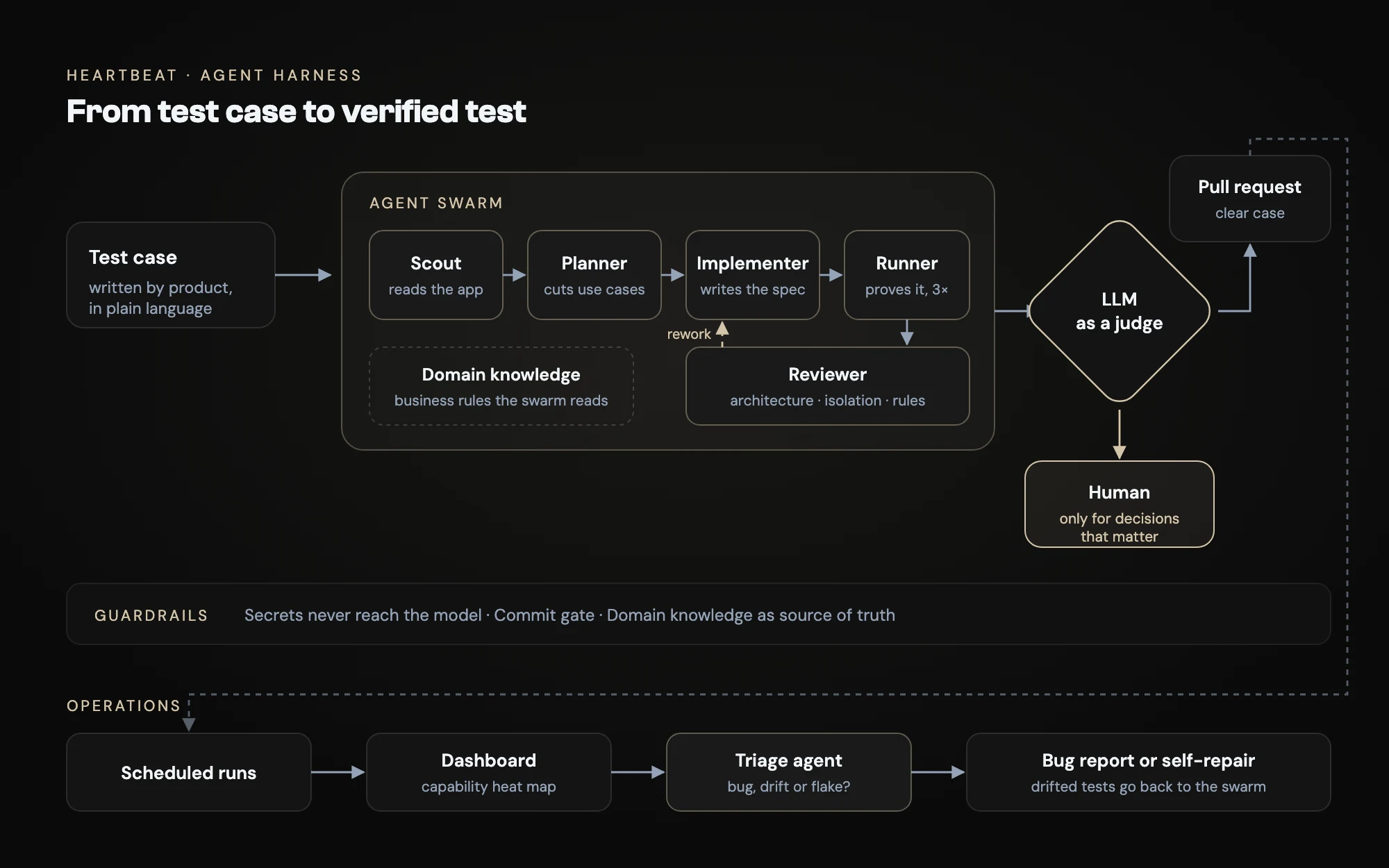
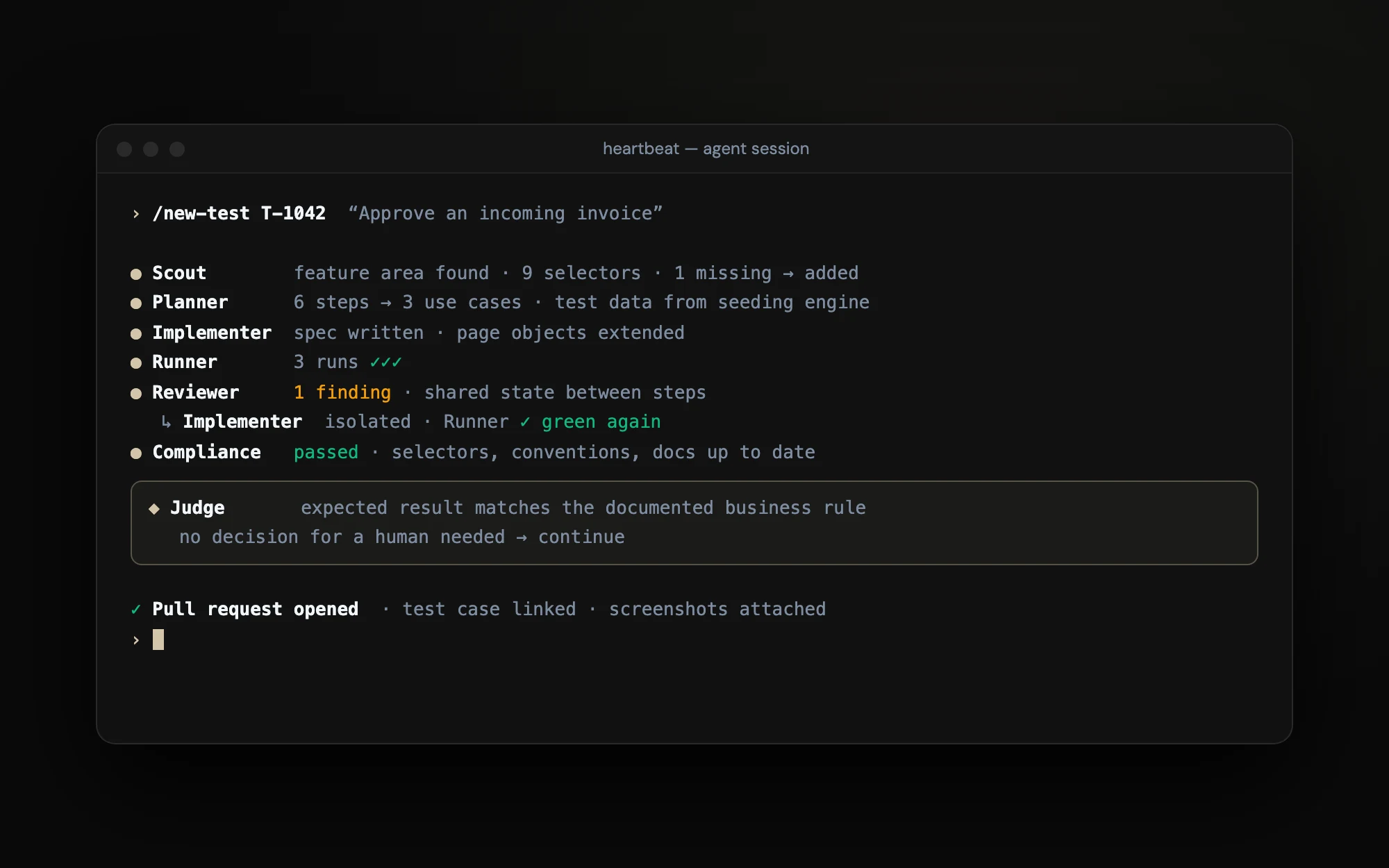
From test case to verified test. Every test case from test management is checked first: can it be automated, is it already covered, does it match the business logic? Then five agents work one after the other. First the scout reads the current state of the application and finds stable selectors. The planner splits the test case into use cases and sets the test data. The implementer writes the Playwright test, the runner proves it in several runs in a row, and the reviewer checks architecture, isolation and rules. If the reviewer finds something, the test goes back to the implementer until it passes.
LLM as a judge instead of sign-off at every step. At the end, a judge agent decides whether the result is unambiguous. It checks, for example, whether the expected behaviour matches the documented business rule. Clear cases go all the way to a pull request without a question. The judge brings in a person only for a decision that matters, for instance when a business rule has changed.
Every automated step maps to exactly one step in the test case.
Domain knowledge as the source of truth. What a feature is supposed to do lives in dedicated domain documentation. The agents read it before every test and extend it afterwards, so they decide by documented rules and the knowledge grows with every test.
Guardrails. Secrets never reach the agents. Every change has to pass an automated gate: type checks, linting, rule checks and a documentation check.
A system that maintains itself. When the UI changes, an agent finds the affected tests and classifies each drift. It repairs a renamed selector without touching an assertion and hands a changed business rule to a person. After every run, a triage agent separates real app bugs from test failures and flaky runs. It matches them against open bugs and drafts a ticket with a video for each new bug.
The Heartbeat Dashboard. A dedicated web app (React, Nest.js) combines all runs into a map of the platform's capabilities. The heat map shows which capability is healthy, where tests are missing and which open bug sits behind a red test. A cost model compares automation with manual regression. Product owners see the state of the platform without reading a test report.
Impact & Results
- Manual regression effort down by an estimated 90 %. A full regression run takes minutes instead of days.
- Test case and test stay in line. Every test step reports its result with a screenshot to the matching step in test management.
- From test case to pull request without manual work. People decide only where the business logic calls for it.
- Bugs with evidence. A new app bug arrives as a ticket with reproduction steps, screenshots and video.
- State at a glance. The dashboard shows at any time how each capability is doing, what is covered and what automation saves.
- Up-to-date documentation. Domain and framework documentation are checked and updated in the same step as the code.
My Role
Concept, architecture and implementation of Heartbeat, as sole owner. That covers the agent harness with skills, subagents, hooks and guardrails, the Playwright test suite and the integration with test management, issue tracking and CI. It also covers the Heartbeat Dashboard, from data modelling to operations.
Got a similar challenge?
Tell me about your challenge. I'll share how I'd approach it — and a realistic timeline.