PEAX
PEAX Platform: frontend for business mail and administration
Senior Frontend Engineer & Applied AI Engineer
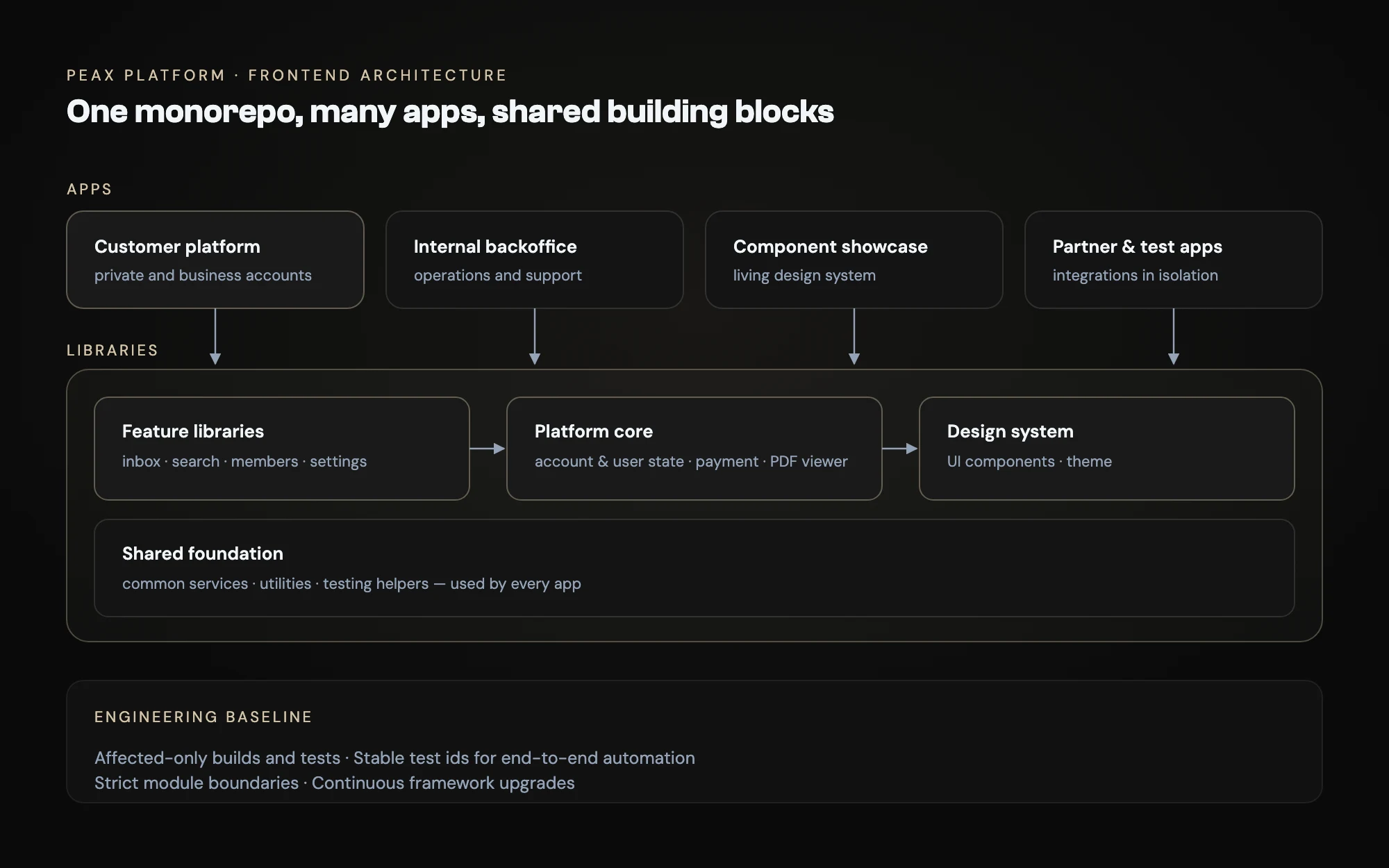
PEAX brings paper mail, digital documents, invoices and payments for private and business customers into one place. The platform recognises documents, routes them, pays them and archives them, also in companies with members, roles and distribution groups. The frontend is an Angular monorepo in which several apps share common building blocks. AI agents fix bugs in it and help with quality assurance.
The Challenge
The platform covers a lot: private and business accounts, members and permissions, mail distribution, payments, subscriptions and identity verification. Every feature follows business rules. Because customers run their payments and documents through PEAX, every change has to meet a high quality bar.
The platform keeps growing, and PEAX keeps it technically current at the same time. A framework upgrade touches large parts of the code, yet every change should stay easy to follow in review. From a bug fix, the team expects more than a green build: evidence that it works.
The Approach
Architecture with clear boundaries. The Nx monorepo holds the customer platform, the internal backoffice, a component showcase and partner apps. They share feature libraries, a common design system and a platform core with account and user state, payment logic and the PDF viewer. Nx enforces the module boundaries and builds and tests only the parts a change affects. State lives in NgRx stores, and new components use signals.
Product work in the frontend. New features and redesigns are built on the new design system, most recently the redesigned document details. The team fixes a bug at its root, with a test that catches exactly that bug from then on. Stable test IDs connect the UI to the end-to-end tests, so a test does not break when the layout or a text changes.
Modernisation in stages. Framework upgrades and larger refactorings go library by library, each stage as its own pull request the team can review. The platform stays current while feature work carries on.
AI in everyday development. AI agents take over recurring work, following fixed workflows with fixed checkpoints:
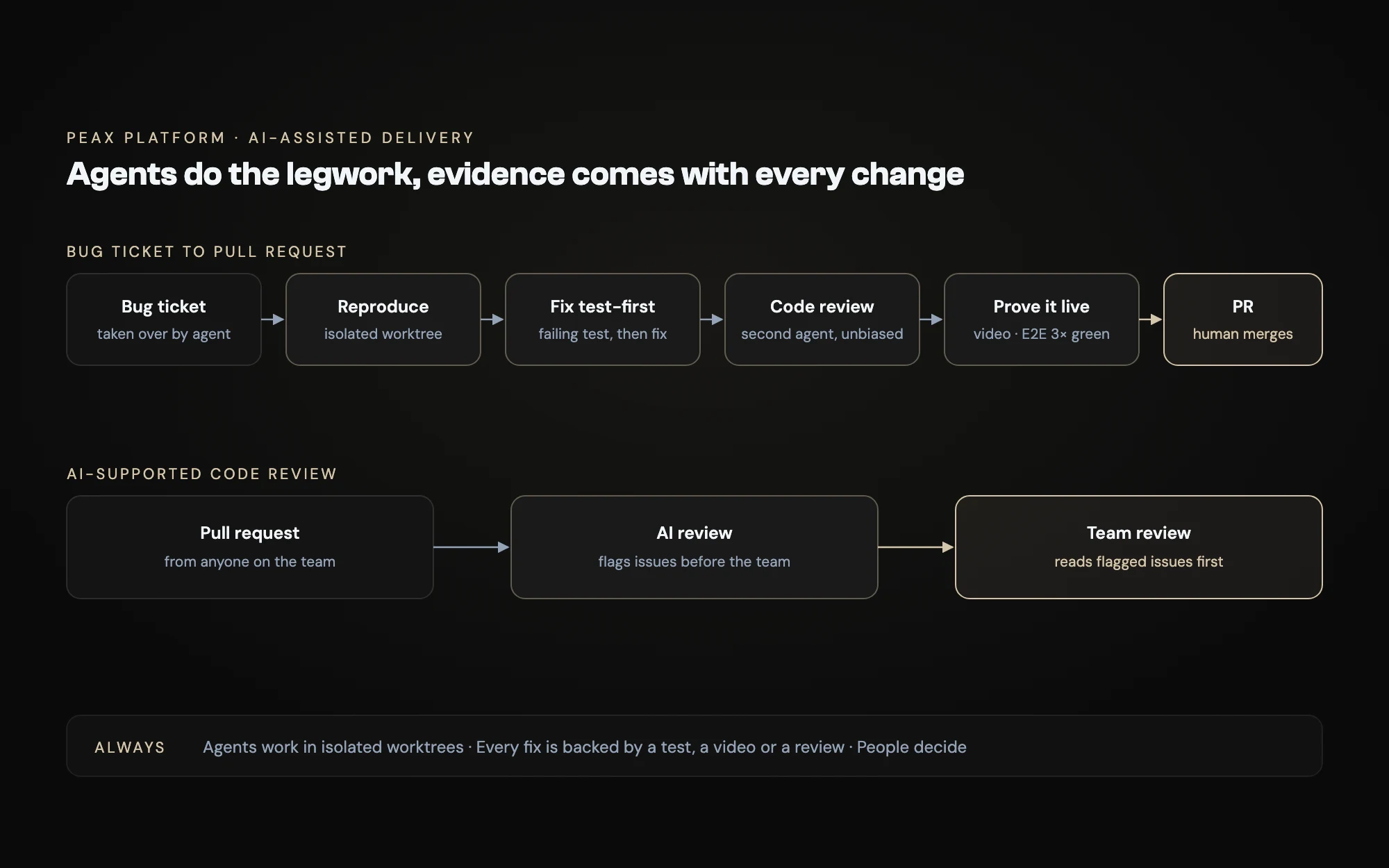
- From bug ticket to pull request. An agent picks up the ticket and reproduces the bug in an isolated worktree. It writes a failing test first, then the fix. Lint and unit tests run, and a second agent reviews the code without bias. For a visible fix, the agent shows it working live in the browser and attaches a video and a screenshot to the ticket. If the ticket has an end-to-end test, that test has to pass several times in a row. Only then does the pull request open, and a person merges it.
- Quality assurance in review. AI reviews pull requests too and flags issues before the team reads them.
Every fix brings its evidence: a test, a video or a review.
Impact & Results
- Modernisation without a feature freeze. Upgrades and refactorings run alongside product work, in small stages the team can review one by one.
- Bug fixes with evidence. Fixes arrive with a test, a video and a review, so the team sees they work before merging.
- More quality in review. Many issues are already flagged when the team opens a pull request.
- A testable UI. Stable test IDs make the platform the base for the end-to-end test framework Heartbeat.
My Role
Senior Frontend Engineer on the platform team: new features and redesigns, bug analysis and fixes through to production, framework upgrades and modernisation. On top of that, introducing AI-assisted workflows in the frontend, from bug fixing by agents to AI support in code review.
Got a similar challenge?
Tell me about your challenge. I'll share how I'd approach it — and a realistic timeline.